

Thiruvananthapuram: On the morning of September 11, 2001, New York City began like any other day. Workers headed to offices, commuters filled the streets and Manhattan moved at its usual pace. Within hours, however, the city became the centre of one of the deadliest terrorist attacks in modern history.
Hijacked aircraft crashed into the World Trade Center towers, sending smoke and flames across Lower Manhattan. Thousands of people trapped inside the buildings faced an unimaginable choice as they searched for a way to escape.
Amid the destruction, Associated Press photographer Richard Drew captured an image that would become one of the most haunting photographs of the attacks.
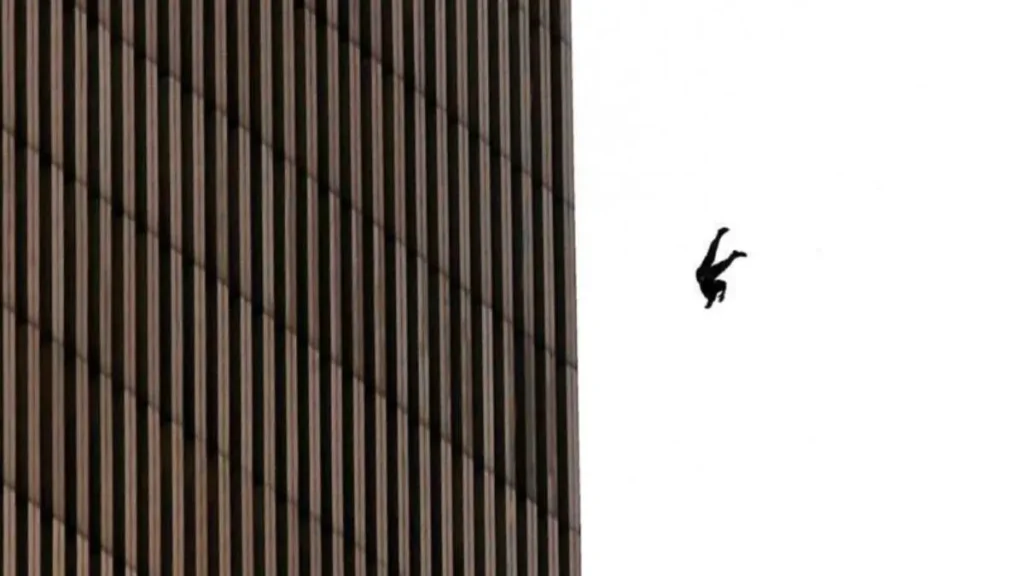
The photograph showed a man falling from one of the towers. His face could not be seen, and his identity was never conclusively established. Over time, the unidentified figure became known simply as “The Falling Man.”
A Moment Frozen in History
Richard Drew had travelled to the area for a different assignment. After news of the attacks spread, he rushed toward Lower Manhattan with his camera.
What he encountered was beyond anything he had expected. People were falling from the burning towers as smoke and flames filled the skyline.
Drew began photographing the unfolding tragedy.
Among the frames he captured, one image stood out. It showed a man falling almost vertically, his body appearing unusually straight against the sharp geometric lines of the World Trade Center.
The composition made the photograph appear strangely calm despite the chaos surrounding it. Yet the reality behind the image was devastating. Drew had photographed the final moments of a human life.
The Mystery Behind the Photograph
After newspapers published the photograph, a difficult question emerged: Who was the man in the picture?
Journalists, researchers and families spent years attempting to identify him. Some reports suggested that he might have been an employee of Windows on the World, the restaurant located near the top of the North Tower.
Several possible identities were proposed over the years. However, none was officially confirmed.
The uncertainty eventually gave the photograph a significance beyond the individual shown in the frame.
The unidentified man came to represent not just one victim, but the thousands of people who lost their lives on September 11 and the families left behind to mourn them.
A Photograph That Divided Public Opinion
The publication of the image also triggered a major debate about the ethics of photojournalism.
Several newspapers printed the photograph on the day after the attacks. Some readers questioned whether the final moments of someone’s life should be displayed publicly.
Critics argued that publishing the image could cause additional pain for grieving families and turn a deeply personal tragedy into a public spectacle.
Others defended the photograph as an important historical record.
Drew did not photograph the scene to sensationalise a death. He documented what was happening in front of him.
Instead of showing only burning buildings, thick smoke and destruction, the photograph focused attention on a single human being.
That human element made the image powerful. It also made it extremely difficult to look at.
9/11 Was Bigger Than One Photograph
The attacks began on September 11, 2001, when 19 al-Qaeda terrorists hijacked four commercial passenger aircraft.
Two planes crashed into the World Trade Center towers in New York. Another aircraft struck the Pentagon in Arlington, Virginia. United Airlines Flight 93 crashed into a field near Shanksville, Pennsylvania, after passengers and crew members attempted to regain control of the aircraft.
The attacks killed 2,977 people, including civilians, firefighters, police officers, emergency workers and airline crew members.
Flight 93 later became a symbol of resistance during the attacks.
Passengers learned about the other hijackings through telephone calls and conversations with people on the ground. As they understood what was happening, several contacted their families and shared their final messages.
Some passengers said goodbye to their loved ones. Others discussed confronting the hijackers.
At approximately 9:57 a.m., passengers and crew members began moving toward the cockpit.
Their actions prevented the aircraft from reaching its intended target. Flight 93 eventually crashed into a field near Shanksville, killing everyone aboard but potentially preventing another attack on people on the ground.
25 Years Later, The Question Still Remains
A quarter of a century after the attacks, New York has changed dramatically.
The World Trade Center site now includes the 9/11 Memorial, where the names of those who died are inscribed in remembrance.
Yet the identity of the man captured in one of the most recognisable photographs from that morning remains uncertain.
That unanswered question has become part of the photograph’s enduring impact.
“The Falling Man” does not tell the story of just one person. Instead, it reflects the grief experienced by thousands of families who lost parents, children, spouses, partners, friends and colleagues.
Behind the headlines were countless individual stories — final phone calls, desperate attempts to escape, strangers helping one another and emergency workers putting their own lives at risk to save others.
That is why “The Falling Man” remains more than a photograph from September 11.
It is a quiet reminder of the human cost of the attacks and of the lives that were suddenly lost on one of the darkest mornings in modern history.
Even 25 years later, the image continues to make people stop, look and remember.
