

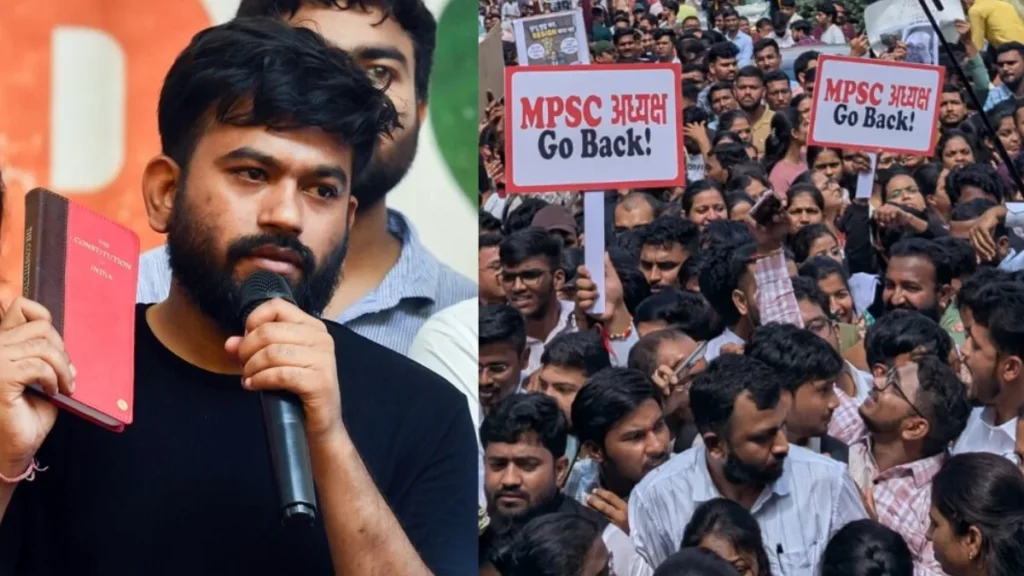
Aspirants have taken to the streets in several cities across Maharashtra to protest against the MPSC paper leak controversy. Following demonstrations in Pune, Nagpur, and Nashik, the movement is likely to expand further with the involvement of the CJP.
Mumbai/Chhatrapati Sambhajinagar: The agitation by Maharashtra Public Service Commission (MPSC) aspirants over alleged examination irregularities and the Drug Inspector question paper leak is gaining momentum. The Cockroach Janata Party (CJP) has now announced its support for the protesting candidates and demanded accountability from the commission’s top leadership.
CJP founder Abhijit Dipke has backed the aspirants’ demands and called for the resignation of MPSC Chairman Vivek Bhimanwar and Secretary Mahendra Harpalkar. The organisation has given the authorities until September 24 to respond, warning that a statewide protest campaign will follow if no concrete action is taken.
The dispute has also brought renewed attention to the security and credibility of Maharashtra’s recruitment examination system. Aspirants are seeking stronger safeguards for future examinations, particularly the Group-C preliminary examination scheduled for October 2026.
CJP Extends Support to MPSC Aspirants
A group of MPSC aspirants recently met Abhijit Dipke at his residence in Waluj, Chhatrapati Sambhajinagar, according to a statement released by the CJP.
After the meeting, Dipke said the organisation would stand with the candidates in their ongoing campaign. He maintained that the CJP would continue supporting the movement until the aspirants’ concerns over accountability at the commission were addressed.
The organisation has fixed September 24 as the deadline for the government and concerned authorities to respond to the demands. If no satisfactory action is taken, the CJP plans to travel to different parts of Maharashtra and organise protests along with students preparing for competitive examinations.
The CJP’s involvement could widen the scope of the agitation. However, the protest itself began as an aspirants-led campaign against alleged irregularities in recruitment examinations and the reported leakage of an examination paper.
Drug Inspector Recruitment Under Scrutiny
The Drug Inspector Group-B screening examination has emerged as the central issue in the ongoing MPSC controversy.
The examination was conducted on March 22, 2026. Allegations subsequently surfaced that the question paper had been accessed by certain individuals before the test. Following the allegations and subsequent investigation, MPSC cancelled the recruitment process and announced that the examination would be conducted again.
The Mumbai Crime Branch took up the investigation and arrested several people in connection with the case. Those arrested include three MPSC officials and a candidate who had secured seventh position in the examination.
Investigators have alleged that the accused obtained access to the question paper before the examination, created another set and allegedly circulated it to people who were not authorised to possess it.
Police have further alleged that the seventh-ranked candidate received the paper before the examination. According to the investigation, she was allegedly advised to deliberately give 10 wrong answers so that her performance would not raise suspicion.
These are allegations made during the investigation and will be subject to the legal process.
MPSC Officials Among the Accused
The alleged involvement of officials working within MPSC has added another layer to the controversy and prompted questions about the commission’s internal controls.
Among those arrested are MPSC Under Secretary Abhijit Ganpatrao Lendwe and Assistant Section Officers Vishweshwar Dattatray Nakte and Gopal Bhattu Marathe.
The investigation also names Pravin Dileep Patil, director of Kautilya Academy in Nandurbar, as well as Amrut Namdev Patil and Lokesh alias Gaurav Rajendra Patil. Rutuja Patil, the candidate who reportedly secured seventh rank, was arrested subsequently.
The case has triggered questions about the safeguards surrounding examination papers, including their preparation, storage and movement before they reach examination centres.
Aspirants argue that allegations of unauthorised access to confidential material can undermine confidence in the wider recruitment process and make it necessary to review the commission’s examination security arrangements.
Aspirants Protest in Pune, Nagpur and Nashik
The protests have spread to several cities across Maharashtra.
In Pune, a large group of aspirants took part in a protest demanding an independent probe into the alleged paper leak. They also sought the removal of the MPSC chairman and secretary. Opposition leaders participated in the agitation as well.
The protesters have also raised concerns about examinations other than the Drug Inspector recruitment test. They have questioned alleged irregularities in certain examinations and results and demanded greater transparency in the selection process.
In Nagpur, students associated with the Vidarbha Competitive Examination Coordination Committee called for a high-level investigation and demanded the resignation of the MPSC chairman. A memorandum addressed to Chief Minister Devendra Fadnavis was submitted through the district administration.
Similar protests were held in Nashik, where hundreds of candidates gathered outside the district collector’s office. Protesters demanded an independent probe into the alleged paper leak, with some seeking an investigation by an agency such as the Central Bureau of Investigation.
The protests indicate that the issue has now moved beyond one recruitment examination and developed into a broader debate over the functioning and credibility of the state’s competitive examination system.
Key Demands of the Protesters
The aspirants have placed several demands before the government and MPSC.
One of their primary demands is a comprehensive investigation into the alleged Drug Inspector question paper leak. They have also sought the release of the preliminary investigation report prepared by the Mumbai Crime Branch.
The protesters want a forensic audit of examinations conducted during the tenure of MPSC official Abhijit Lendwe. They have also raised concerns regarding the evaluation of answer sheets in the 2025 State Services Main Examination and Agriculture Services Examination.
Candidates are demanding that alleged irregularities in these examinations and questionable results in other recruitment tests be examined separately.
Another important concern is the upcoming Group-C preliminary examination in October 2026. Aspirants want the commission to ensure strict security arrangements and a transparent examination process so that candidates do not face doubts over the integrity of the test.
Also Read :- 25,000 Students Make Clay Ganesha Idols Together, Guntur’s ‘Green Ganesh’ Sets World Record
Not in Office When Incident Occurred
MPSC Chairman Vivek Bhimanwar has rejected allegations that seek to hold him responsible for the Drug Inspector examination controversy.
In a statement issued on September 2, Bhimanwar pointed out that the alleged irregularity took place in January 2026. He said he took the oath as MPSC chairman on February 18 and assumed charge on March 3.
According to Bhimanwar, the incident therefore occurred before he formally took charge of the commission.
He also said MPSC had treated the allegations seriously and approached the police. The commission, he added, had constituted an internal high-level committee to examine the issue and recommend steps to prevent similar incidents in future.
The chairman’s explanation, however, has not convinced the protesting aspirants, who continue to demand accountability from the commission’s leadership.
MPSC Secretary Faces Black Powder Attack
The confrontation surrounding the MPSC controversy intensified further on September 11 when black powder was allegedly thrown at Secretary Mahendra Harpalkar at the commission’s headquarters in Navi Mumbai.
Three people were arrested by the police in connection with the incident.
The incident took place against the backdrop of the ongoing agitation over the alleged question paper leak. Student organisations condemned the attack and maintained that candidates’ grievances should be raised through peaceful and lawful forms of protest.
Chief Minister Devendra Fadnavis has also warned against attempts to turn the agitation into a political confrontation. He said the government was examining the concerns raised by aspirants and would continue taking action against those found responsible for examination-related irregularities.
Maharashtra Government Begins Examination System Review
The continuing protests have prompted the Maharashtra government to focus on wider reforms in the recruitment examination system.
During a meeting with aspirants, Chief Minister Fadnavis assured them that the government would examine issues related to answer-sheet re-evaluation, alleged paper leaks and the overall examination process.
A high-level committee headed by senior bureaucrat V. Radha has been formed to review the system and recommend measures to make examinations safer and more transparent.
The committee is collecting views from candidates, parents, teachers and other stakeholders. It is also travelling to different revenue divisions to understand the problems faced by aspirants and assess the existing examination arrangements.
The committee is scheduled to visit Nagpur on September 16 as part of its review process.
CJP’s Entry Could Intensify Pressure
The CJP’s decision to formally support the MPSC aspirants could put additional pressure on the state government and the commission.
Abhijit Dipke has previously participated in campaigns related to competitive examination issues. His latest announcement means the CJP is likely to remain involved in the MPSC agitation in the coming days.
The organisation has warned that it will begin a wider statewide campaign if the authorities fail to act by September 24. Protests could subsequently expand to cities including Pune, Nagpur, Nashik and Chhatrapati Sambhajinagar.
For the government, the immediate challenge is to address the concerns of aspirants while implementing the examination reforms already announced.
With the Group-C preliminary examination scheduled for October, restoring candidates’ confidence in the recruitment system has become a key issue. Whether the government’s proposed reforms will satisfy the protesters or whether the demand for the resignation of the MPSC chairman and secretary will continue to drive the agitation remains to be seen.
